
-

Wyślij do nas e-mail
sale@lscmagnetics.com -

Numer kontaktowy
+86 -13559234186
Wyślij do nas e-mail
sale@lscmagnetics.comNumer kontaktowy
+86 -13559234186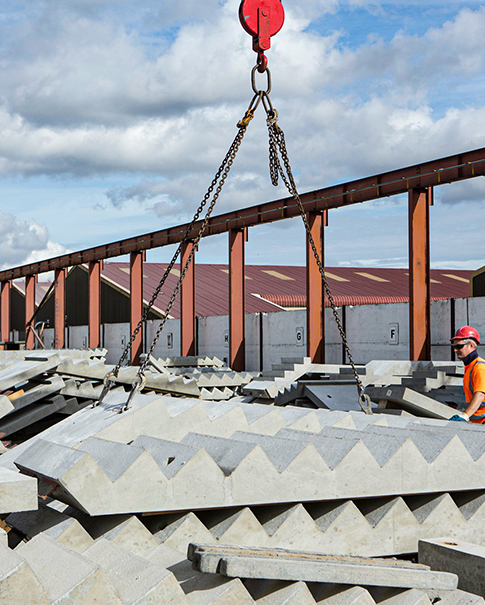

Key Advantages of Using Precast Concrete Formwork in Construction Projects
Sep 18, 2026On construction sites, formwork plays an awkward role—it determines the shape of the concrete, but after pouring, it must be dismantled, cleaned, and re-erected, a cycle that continues until it's unusable. Wooden formwork deforms after three to five uses, while steel formwork is heavy and relies on machinery. However, there is a type of formwork that does not need to be removed after pouring, becoming a permanent part of the building—this is precast concrete formwork.
Precast concrete formwork consists of slab-like components made of concrete or reinforced concrete, prefabricated in a factory or on-site. These are installed on the structural surface for pouring and shaping, and do not need to be removed after pouring, becoming a permanent part of the building. Its fundamental difference from traditional formwork lies in its "dual-purpose" nature: it functions as a mold during construction and as a structural protective layer or enclosure during use.
This technical approach is called "PCa permanent formwork" in Japan. In the construction industry, it is often used for semi-precast formwork of floor slabs and walls. In the civil engineering field, its high durability is emphasized—not only for saving labor but also for extending the structural lifespan.
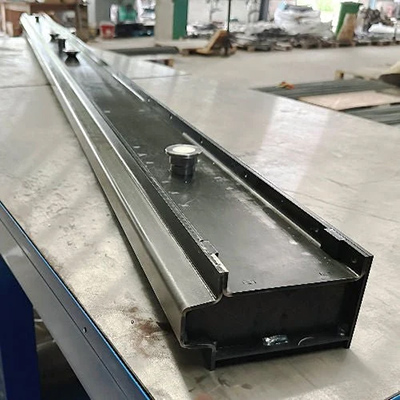
The core pain point of traditional formwork engineering is the "cycle"—formwork erection, pouring, curing, formwork removal, cleaning, and re-erection. Precast concrete formwork remains in place after pouring, completely eliminating the formwork removal step.
Pile foundation construction is a typical scenario. Traditional brick formwork requires manual masonry, internal plastering, and waiting for the formwork to reach the required strength before waterproofing can be applied, resulting in a large workload and long cycle. Using precast concrete formwork (slab formwork) allows for faster assembly; the assembly time for a 2.5m×2.5m×1.4m pile foundation formwork can be controlled to 0.125 man-days, while traditional brick formwork masonry requires 0.5 man-days. The surface flatness of precast slabs is far superior to brick masonry, allowing for direct waterproofing construction without plastering, saving the curing time required for mortar strength.
In the application of Jinan Metro Line 8, ultra-large precast, assembled, and non-dismantling UHPC formwork was used in metro station construction, achieving integration of "construction formwork" and "permanent structure." On-site work only required component positioning and rapid connection, significantly reducing workload and worker labor intensity.
The precast concrete formwork remains within the structure, not passively "occupying space." Research data shows that reinforced concrete beams with permanent formwork exhibit significantly improved bending performance compared to traditional beams.
Studies have tested U-shaped ECC permanent formwork composite beams, observing significant improvements in bending capacity and crack resistance. Another test on high-fiber cement-based precast shells showed a 6.6% increase in yield load and a 10.3% increase in peak load, with reliable yield delay and bearing capacity models. This means that, under the same design requirements, using permanent formwork allows for a smaller concrete cross-section, resulting in a slimmer cross-section and a lighter structural self-weight.
Wooden formwork is susceptible to water, insects, and deformation; steel formwork is heavy and prone to rust during handling. Precast concrete formwork, being a concrete product itself, boasts high load-bearing capacity and extremely high durability, is less affected by external environmental factors, and requires minimal maintenance. If used as permanent formwork, its lifespan is equivalent to that of the main structure.
UHPC (Ultra-High Performance Concrete) precast formwork further amplifies this advantage. UHPC material endows the formwork with high strength, toughness, and durability. Combined with poured concrete, it effectively resists construction loads and environmental erosion, improving the overall structural performance and long-term service life. In bridge applications, the high impermeability and crack-resistant protective layer of the non-removable UHPC precast slabs effectively prevent harmful substances such as chloride ions from penetrating the concrete.
The environmental impact of wooden formwork is often underestimated. Our country's forest resources are limited; the extensive use of wooden formwork generates negative environmental impacts. The residual value of scrapped wooden formwork is extremely low, and the vast majority can only be disposed of as waste.
The environmental advantages of precast concrete formwork are twofold. On a direct level, replacing wood with concrete reduces forest resource consumption. At a deeper level, it leads to life-cycle carbon reduction. A 2025 study integrating structural modules with a life-cycle CO₂ calculator compared traditional and permanent formwork designs, showing that permanent formwork solutions can achieve approximately 20% CO₂ reduction (depending on specific configurations). The emission reduction effects from reduced cross-sections and concrete usage cannot be fully captured by simply "not removing the formwork."
Improved Quality Control
Factory prefabrication results in components with geometric precision and surface smoothness far exceeding traditional formwork. The precision of the formwork itself is directly transferred to the final concrete surface. In box girder prefabrication, box girders using galvanized steel plate formwork have a mirror-like surface, "reflecting a person's image," reducing demolding time from 7 hours to 6 hours and increasing formwork life from approximately 300 cycles to 500 cycles.
Limitations to Consider
Precast concrete formwork is not a panacea. Its flexibility is relatively low, requiring pre-design and manufacturing, making on-site adjustments difficult. Its significant weight necessitates the use of lifting equipment for hoisting. For complex, highly curved, irregularly shaped structures, the processing difficulty and cost of traditional precast concrete formwork increase significantly. In these scenarios, alternatives such as 3D-printed formwork may be more suitable.
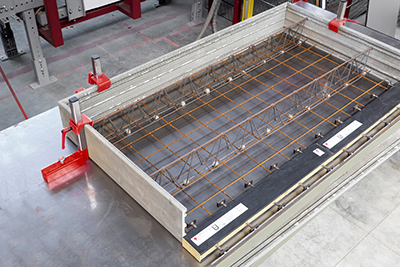
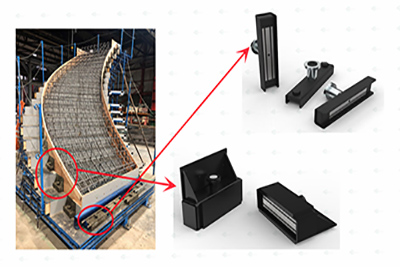
Precast concrete formwork is most advantageous in long-span, high-load structures, such as bridges and large industrial plants. It also has mature applications in special projects such as nuclear power plant spiral structures and dam cantilever structures. In the construction field, semi-precast permanent formwork is widely used for floor slabs and walls, and the application of thin-plate permanent formwork in construction has been increasing in recent years.
Precast concrete formwork represents a shift in thinking: from "borrowing and returning molds" to "making the mold an integral part of the building itself." When formwork is no longer a disposable consumable but rather part of the structure, construction processes are simplified, material efficiency is redefined, and the carbon emission balance is subtly rewritten. Against the backdrop of rising labor costs and tightening timber resources, the economic logic of this technological approach is becoming increasingly clear.
Q1: What is the difference between precast concrete formwork and ordinary concrete formwork?
Ordinary formwork is temporary, removed and reused after pouring; precast concrete formwork is permanent, not removed after pouring, and becomes part of the building structure. The mission of traditional formwork is to "shape and leave," while the mission of precast concrete formwork is to "shape and remain."
Q2: Is it more expensive than wooden formwork?
The initial purchase price is usually higher, but the overall cost may be lower. Wooden formwork is reused 3–5 times and then scrapped, with almost zero residual value; the cost of precast concrete formwork is absorbed by the structural protective layer, and it saves on labor costs for demolding, cleaning, and repairs.
Q3: Is lifting equipment needed during construction?
It depends on the size and weight of the component. Larger precast concrete formwork components require lifting equipment for hoisting, and lifting rings need to be pre-embedded during precasting. This is one of the reasons why it is not as flexible as lightweight plastic formwork in some scenarios.
Q4: What types of construction projects is it suitable for?
It is most suitable for projects with large spans and high loads, such as bridges and industrial plants. It is also used in highly standardized residential projects. However, for complex shapes and irregularly shaped structures with large curvatures, the processing difficulty and cost of traditional precast concrete formwork will increase significantly.
Q5: What is its surface quality like?
Precast concrete formwork is itself a concrete product, and its surface flatness and smoothness are controllable. If it is used as a permanent exposed surface, the quality of the mold needs to be controlled during prefabrication. When used as stay-in-place formwork, the flatness of its inner side (the surface in contact with the cast-in-place concrete) affects the final structural surface effect.
Q6: What precast concrete formwork products are available on the market?
Precast concrete formwork belongs to the "stay-in-place formwork" category and is listed alongside permanent insulation formwork in the concrete formwork market. Typical products include precast concrete slabs and reinforced concrete permanent formwork, which are usually customized according to project requirements.
Whatsapp : +86 -13559234186
E-mail : sale@lscmagnetics.com
Tel : +86 -13559234186